
Why Profit Does Not Equal Cash Flow for Small Businesses
Quick Summary: A profitable business can still feel short on cash—and that is more common than many owners realize. Profit measures what your business earned after expenses, while cash flow tracks the actual money moving in and out of your bank account. Understanding the difference helps you plan ahead, avoid surprises, and make more confident financial decisions.
Why Profit Doesn’t Equal Cash
When you look at your profit and loss statement, you may see that your business is profitable. That is encouraging, but it does not always mean there is plenty of cash available to spend.
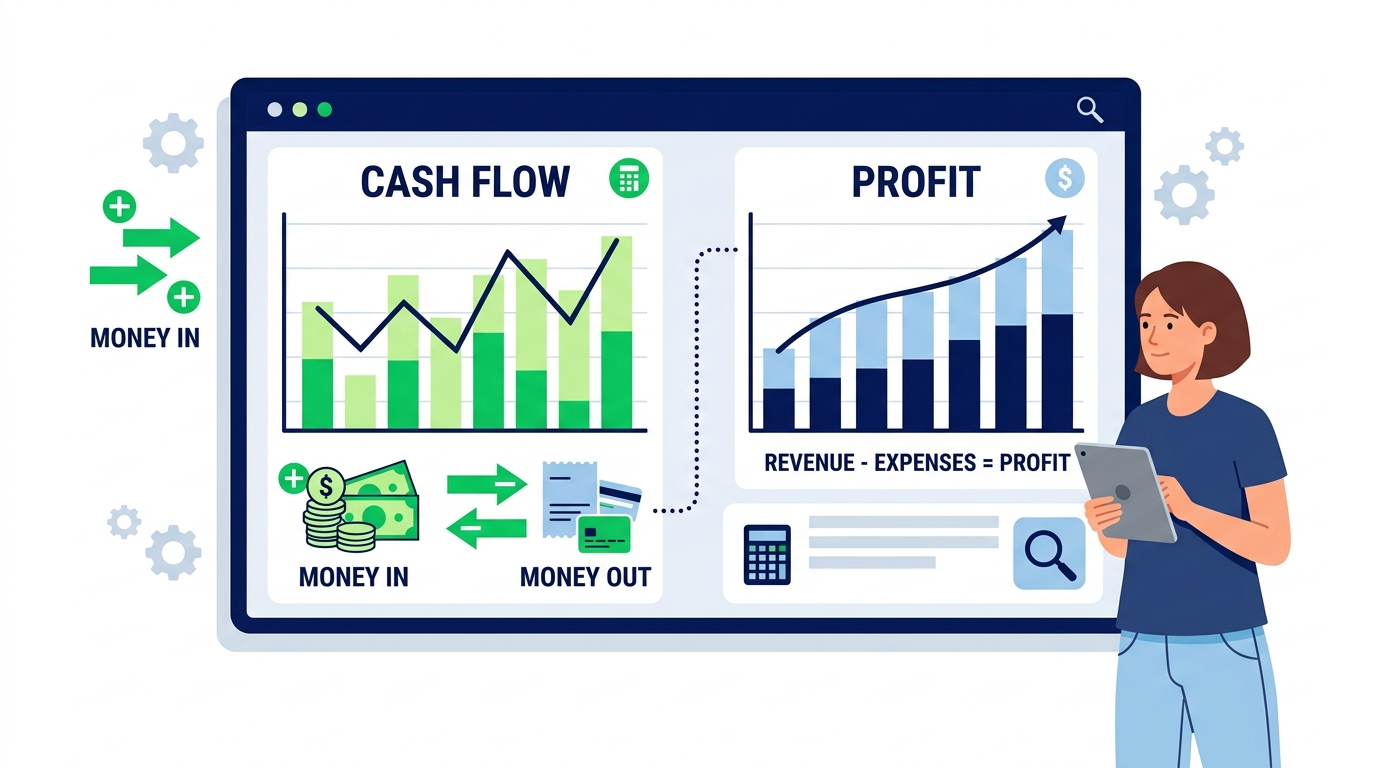
Profit is an accounting measure: revenue minus expenses for a specific period. Cash flow is the real movement of money into and out of your accounts. The two often differ because the timing of earning income, recording expenses, sending invoices, and receiving payments is rarely identical.
For example, imagine your business completes a $15,000 project in June and sends the invoice right away. That income may appear on your June profit and loss statement. But if the client does not pay until August, your business has recorded a profit without receiving the cash yet. In the meantime, payroll, rent, software subscriptions, and vendor bills still need to be paid.
Invoices and Accounts Receivable Can Tie Up Cash
Accounts receivable is simply money your customers owe you. It is an asset on your books, but it cannot cover payroll until it arrives in your bank account.
Slow-paying clients can create a cash squeeze even when sales are strong. If you invoice late, offer lengthy payment terms, or do not consistently follow up on overdue balances, your cash may lag behind your reported revenue.
One practical way to improve cash flow is to establish a consistent invoicing process. Send invoices promptly, clearly state payment terms, monitor outstanding balances weekly, and follow up professionally before invoices become seriously overdue. For some businesses, requesting deposits or milestone payments can also reduce the gap between doing the work and getting paid.
Inventory Requires Cash Before It Produces Revenue
Inventory-based businesses often experience this issue firsthand. You may spend $20,000 on inventory today, but it could take weeks or months to sell those products and collect payment from customers.
Your business may still be profitable on paper, especially if the inventory has not yet been recorded as a cost of goods sold. However, the bank balance reflects the immediate cash outflow. Purchasing too much inventory, ordering too far in advance, or carrying slow-moving products can make cash feel tight quickly.
Reliable numbers help you see how much cash is tied up in inventory and whether your purchasing decisions align with expected sales. This visibility makes it easier to order intentionally rather than relying on a bank balance alone.
Loan Payments, Owner Draws, and Taxes Affect Available Cash
Not every cash payment appears as an expense on the profit and loss statement. This is one of the biggest reasons business owners wonder why profit does not equal cash.
- Loan principal payments: The interest portion of a loan payment is generally an expense, but the principal repayment reduces debt rather than profit. The full payment still leaves your bank account.
- Owner draws: Money taken from the business by an owner is generally not a business expense, but it reduces cash available for operations.
- Taxes: Income taxes, sales tax obligations, payroll taxes, and estimated tax payments can create significant cash needs. Planning for business taxes throughout the year helps prevent stressful surprises.
- Payroll: Payroll is often one of the largest and most time-sensitive cash obligations. Even a profitable business needs enough cash on hand to pay employees, payroll taxes, and benefits on schedule.
For instance, a business might show a $10,000 monthly profit but make a $6,000 loan principal payment, take a $3,000 owner draw, and send $4,000 for quarterly taxes. The business was profitable, but its cash balance decreased by $3,000 before considering other timing differences.
Large One-Time Expenses Can Change the Picture
Some purchases are necessary for growth but can put pressure on cash in the short term. Replacing equipment, investing in new technology, paying an annual insurance premium, moving into a larger space, or covering a major repair may require a large payment all at once.
Depending on the purchase, the expense may be spread across multiple months or years in the accounting records. Yet the cash leaves the bank immediately. Without a cash plan, a healthy-looking profit and loss statement can feel disconnected from what is actually available.
How to Improve Cash Flow With Better Visibility
Improving cash flow starts with understanding the timing of your money. Rather than only reviewing your profit and loss statement, business owners should regularly look at bank balances, outstanding invoices, upcoming payroll, tax obligations, debt payments, inventory needs, and major planned purchases.
Strong bookkeeping creates the foundation for this work. Accurate, up-to-date records provide reliable numbers, reveal where cash is going, and make it easier to spot problems before they become urgent. Monthly accounting services can also help you track trends instead of trying to reconstruct the story after a difficult month.
A simple cash-flow forecast can be especially valuable. It estimates the cash you expect to receive and pay over the coming weeks or months. It is not about predicting every dollar perfectly; it is about identifying likely shortfalls early enough to adjust spending, accelerate collections, plan financing, or set aside funds for taxes and payroll.
How a Fractional CFO Supports Better Decisions
A fractional CFO provides higher-level financial guidance without the commitment of hiring a full-time chief financial officer. For growing businesses, fractional CFO support can help connect bookkeeping data to practical decisions about pricing, hiring, owner compensation, expenses, financing, and growth plans.
At Prosperity Financial Accounting, we combine clear bookkeeping with proactive financial guidance to help business owners understand what their reports mean in real life. As a remote accounting firm, we help clients build financial clarity around cash flow, profitability, tax planning, payroll services, and the decisions that shape their business.
When you know your numbers, you do not have to rely solely on a hopeful bank balance or a profitable month on paper. You can make decisions with a clearer understanding of what is coming next and greater business financial confidence.
Get Clearer About Your Cash
If your business looks profitable but cash still feels uncertain, Prosperity Financial Accounting can help you make sense of the numbers. Our bookkeeping and fractional CFO support are designed to give business owners reliable reporting, clearer cash visibility, and practical guidance for moving forward with confidence.